An emerging, statewide partnership of diverse child care providers working together to bring attention and understanding to the current challenges with publicly funded child care in Colorado.
Change Starts Here
State and Federal Funding Shortfalls Threaten Child Care for All Colorado Kids
Public funding for child care is essential to young children, working parents, the child care industry & Colorado’s economy. However, policy and budget choices at the federal, state and local levels are limiting access for Colorado’s working families & undermining an already fragile infrastructure.
What is at risk?
Child care is already hard to find and expensive to afford in Colorado. In fact, even before this crisis, 51% of Colorado’s population lived in a “child care desert.” CCCAP is an essential part of the child care funding picture. Without it, many child care providers will lay off staff, reduce capacity or close all together, putting even greater strain on Colorado families.
Who is impacted?
Children – More than 27,000 Colorado children relied on CCCAP for early care and education and out-of-school time programs in fiscal year 2024-25. These programs enrich learning and support healthy development between the ages of birth and 12 yrs old. They also ensure kids have a safe and nurturing place to be while their parents work or are in school or job training. As of Feb 1st, more than 13,500 children are being impacted by enrollment freezes and waiting lists.
Working Parents & Their Employers – CCCAP helps pay for child care for parents who are working or pursuing education and/or training. 18,000 Colorado families depend on CCCAP for financial stability while Colorado employers need a reliable and present workforce, including parents.
Child Care Providers – CCCAP is an essential part of the child care funding picture that helps support more than 2,500 child care businesses, including 2,400 licensed providers and more than 110 qualified license-exempt (Family, Friend and Neighbor) providers across the state. Many child care businesses are small, woman and / or minority owned.
Colorado’s Economy – Employed parents who lose their CCCAP support will struggle to continue working, hurting Colorado’s economy. A Common Sense Institute report from October 2025 found that a 20% reduction in employment among parents with a child receiving CCCAP (a decline of 2,667 people), would result in Gross Domestic Product (GDP) decline of more than $1B. Even before this crisis, it was estimated by the Center for American Progress that Colorado lost about $3B per year in unrealized income due to a lack of child care.
Actions Taken
March 2026 - CCCAP Rules Re-Write
In March 2026, CDEC released a proposed rules package intended to increase transparency and accountability for financial management of the CCCAP program and ensure better alignment between state and county administrators. The Leadership Team of the Child Care Provider Action Network (CCPAN) has carefully reviewed the rules package and generally supports its goals and direction.
However, we also identified several opportunities to strengthen both the content of the rules package and the process for engaging provider input in CCCAP administration.
Click here to see the sign on letter several providers submitted to Dr. Roy re: concerns with the CCCAP rules re-write.
Click here to read Dr. Roy’s response to those providers.
Testifying
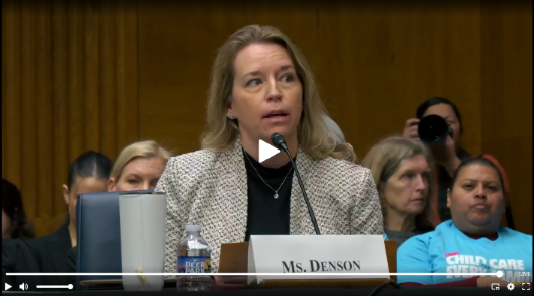
February 12th, Liz Denson, CEO of Early Connections Learning Centers in Colorado Springs testified before the U.S. Senate’s Health, Education, Labor and Pensions (HELP) Subcommittee, speaking to the importance of the federal Child Care and Development Fund (CCDF) and child care assistance programs.
At the hearing, titled “Restoring Integrity: Preventing Fraud in Child Care Assistance Programs,” Denson offered provider perspective on the value and importance of public investment in child care. “CCDF is essential infrastructure for working families and for a functioning economy. It supports parents’ ability to work, providers’ ability to operate, and young children’s access to stable early learning environments during the most formative years of development,” Denson said.
Denson was invited to testify at the request of Senator John Hickenlooper’s office. Her comments come at a critical time as Colorado is one of five states from which the federal government is attempting to withhold essential funding. Huge kudos and deep appreciation to Liz for her leadership and advocacy on a national stage!
You can watch a recording of the hearing here and read Denson’s written remarks here.
How This Impacts Providers


Teaching Tree Early Childhood Learning Center
Funding Gaps Threaten Successful Larimer County Early Learning Centers
Not long ago, Teaching Tree Early Childhood Learning Center was on solid ground. Between 2020 and 2022, the nonprofit doubled the number of children it served at its Fort Collins facility. By 2024, they’d quadrupled in Loveland, creating a “one-stop shop” with wraparound services like behavioral and speech therapy for more than 540 students.
Now, as state CCCAP funding withers, Teaching Tree’s work is in jeopardy. Due to federal and state policy changes and funding shortfalls, Larimer and Weld Counties - the two counties Teaching Tree serves - have imposed CCCAP enrollment freezes, resulting in reduced access to care for low income families who qualify for the child care subsidies and reduced revenue for child care providers who serve them.
Larimer and Weld are not alone. Nineteen Colorado counties have responded to unfunded mandates by freezing CCCAP enrollment, meaning that when a child moves or ages out of the school the vacated slot remains unfilled. Another five counties have created waitlists. Although Teaching Tree’s mission is to have 40 percent CCCAP-qualified children, it hasn’t reached that goal recently. The reductions could end up costing the center about $50,000 per month if Teaching Tree commits to continuing to serve enrolled families shut out of CCCAP. “When there's no more funding for the counties from the state, the shortages unfortunately fall upon the families,” says Anne Lance, Teaching Tree’s executive director.
This is because parents who are unable to afford child care reduce their work or training hours or leave the workforce altogether, with profound implications for the entire economy. A 20% reduction in employment among CCCAP-qualified parents would result in a GDP decline of more than $1B. (Colorado already loses $3B per year in unrealized income because of inadequate child care.) “Employers miss out on hiring the people they're really looking for,” says Karrie Grama-Hatfield, Teaching Tree’s resource development director. “Some of the best talent ends up at home instead, needing to care for a child. So, there are huge ripple effects.”
As Teaching Tree assesses potentially dire effects on its programs, staff, and mission, they’re hoping for relief from the General Assembly. “If legislators don’t act to fund CCCAP,” Grama-Hatfield says, “we can only absorb that $50,000 per month for so long. That’s obviously not going to be sustainable.”
Larimer & Weld County
Mile High Early Learning
Denver County
Denver’s Largest CCCAP Provider Warns Infant-Toddler Care Is Disappearing
For more than 50 years, Mile High Early Learning has anchored early childhood education. Today, the Denver nonprofit serves roughly 400 children across six centers and supports another 180 at 10 partner sites. It’s also Denver County’s largest provider for families using the Colorado Child Care Assistance Program (CCCAP).
Now, leaders fear the county’s enrollment freeze—imposed with two weeks’ notice in January 2025—has put infant and toddler care on a path to extinction.
When the freeze began, Mile High had 150 children enrolled through CCCAP. That number has already fallen to about 135, and no new children can replace those who age out or leave. The organization estimates it lost $250,000 in the first six months of 2025, expects $400,000 less in 2026 CCCAP revenue, and another $600,000 reduction in 2027. Mile High will be serving 40% fewer children by 2027 with continuing decreased capacity.
The consequences are already apparent. Mile High has closed two centers and reduced capacity by 40 children, primarily infants and toddlers—care that is both the most expensive to provide and the hardest for families to find.
The freeze stems from a mix of factors, including federal policy changes that were intended to make child care more affordable—but had no new funding attached. Counties have responded by limiting access, and statewide, roughly 20,000 additional children could lose access as the monetary gap widens.
Unlike public school districts, community-based providers serve working families year-round, longer days, and often offer more comprehensive family support than traditional public preschool programs. Mile High co-locates some of its programs in publicly subsidized housing, which has produced excellent results. “It enables the caregiving adults — parents and teachers — to establish strong interpersonal connections with the children and maintains a robust home-to-school connection for their optimal development,” Harris says.
That progress is now imperiled, as the lack of funding often has a domino effect. “Without accessible, affordable child care, parents miss work more often, have to work fewer hours, and are more likely to lose their job,” Harris says. “Women in particular are much more likely to leave the workforce altogether.”
Without a clear state plan to stabilize infant-toddler funding, Harris fears the erosion will continue. “We’re mission-driven,” she says. “But mission alone doesn’t pay teachers or keep classrooms open.”

Early Connections Learning Centers
Colorado Springs Provider Says Child Care System Is “Held Together by Threads”
Early Connections Learning Centers have served generations of children in Colorado Springs. The 129-year-old nonprofit operates four sites that welcome 250–300 children daily and is expanding infant and toddler care through an $8 million capital project, the fruit of a multiyear fundraising campaign.
But like many Colorado providers, Early Connections says their County’s CCCAP enrollment freeze is devastating an already-fragile child care system. Roughly 60% of the organization’s families rely on CCCAP subsidies. When federal rules required the State to increase payments to providers after not meeting federal standards and also changed other rules in 2024 to cap parent fees and stabilize provider payments—but didn’t provide necessary funding—counties started freezing enrollment to balance their budgets.
The result has been cutbacks that hit the youngest children hardest, at the most crucial time in their development. Currently, all 16 Early Connections’ infant slots are tied to Early Head Start, which covers only part of a workday. Before the freeze, all those families also used CCCAP to pay for the remaining hours. Today, only half can access the subsidy. The rest—low-income parents of newborns—must cover significant out-of-pocket costs or forego care altogether. “We specialize in serving families who can’t afford child care by blending or stacking all available funding sources,” says Liz Denson, Early Connections’ president and CEO. “But we can’t give it away for free.”
Early Connections has absorbed the turbulence for now. Enrollment has climbed back above 90% of capacity after a difficult summer slump. Philanthropy helps bridge funding gaps. As a large, well-established provider with long-standing relationships in the community, Early Connections is finding ways to fill the gaps left by state funding shortfalls - but many smaller child care providers don’t have those options.
And even with private philanthropy, the margins are thin. If CCCAP funding disappears, the impact would be “catastrophic,” forcing classroom closures and layoffs that would affect subsidized and full-pay families alike.
Denson says the organization can still “pull some levers” to survive. But survival is not the same as stability. “Child care is critical infrastructure,” she says. “Right now, we’re holding it together with threads. For decades America has been subsidizing child care on the backs of our teachers and providers, and that just can’t continue.”
El Paso County
How Did We Get Here?
State & Local CCCAP Enrollment
Freezes & Waitlists
The Colorado Child Care Assistance Program (CCCAP) is funded primarily through federal dollars that come to Colorado through the Child Care and Development Fund (CCDF). The program helps families pay for child care if the adults in the family are working, in school or training and / or searching for a job. Federal funds flow through the Colorado Department of Early Childhood (CDEC) to County Departments of Human Services.
In response to federal regulatory changes, state legislation passed in 2024 made policy changes to CCCAP - including capping family co-pays, paying providers prospectively and based on enrollment (not attendance) and changing methodology for reimbursement rates - that increased the cost-per-child served to make child care more affordable for families and to better reflect the actual cost of care.
The federal government did not sufficiently increase funding to states to cover the full cost of these new policies and the State of Colorado was unable to make-up the federal funding shortfall, leaving the counties with unfunded mandates. As a result, several counties have implemented enrollment freezes and waiting lists as a budget management strategy.
Enrollment freezes will shrink CCCAP over time by prohibiting new enrollment. While no one enrolled in the program at the time of the freeze loses their benefit, no one new can access the program. CDEC projects the enrollment freezes could last 5 years or longer, meaning babies born in 2026 would not be able to benefit from CCCAP during their infant, toddler and preschool years.
When a child who was on CCCAP leaves a child care program – e.g. they “graduate” to kindergarten or their family moves to a different county – the child care provider cannot fill the spot with another CCCAP-funded student. This means that child care providers serving low income kids either must
scale back costs, serve fewer children and reduce access to care: reducing hours for teachers, laying off teachers, closing classrooms, closing programs – all of which impacts access to child care for all children, whether they rely on CCCAP funding or not
backfill government shortfalls with private and philanthropic funding, if available and accessible
charge families full tuition costs
Enrollment freezes are currently in effect in 19 Colorado counties, including Adams, Denver, El Paso, Jefferson, Larimer, Mesa, Pueblo, Summit and Weld. Five counties have waiting lists in place.
As of February 1st, there are 13,500+ children who have been unable to access child care because of CCCAP enrollment freezes and waiting lists. Child care providers are already taking steps to reduce costs and capacity and limiting or halting expansion efforts because of these policies.
Withholding of Federal Funding
On January 6, 2026, CDEC received official notice from the Administration for Children and Families (ACF) at the U.S. Department of Health and Human Services that Colorado’s Child Care and Development Fund (CCDF) allocation, the federal funding source that supports CCCAP, is being temporarily restricted based on allegations of fraud.
The funding freeze was set to take effect on January 31, 2026. However, on January 9th, a federal judge temporarily blocked the freeze. The temporary injunction has been extended, and court action is pending. In the meantime, families and child care providers are operating with great uncertainty.
Should the federal Administration not reimburse Colorado for any CCDF expenses for the remainder of Colorado fiscal year 2025-26, it would cost Colorado approximately $91M of lost federal funding.
In The News
-
![]()
Who is watching the babies in Leadville? 10 counties in Colorado have no licensed child care for infants.
Colorado Sun
March 8, 2026“The child care situation, like so many places across Colorado, is so desperate here that parents have postponed having babies or quit their jobs or moved away. Some rely on in-home day cares that are unlicensed and are breaking the law by having more than two children under age 2, including one home that several local residents said takes care of 16 kids, though it has not received a violation notice from state inspectors.”
-
![]()
Opinion: Colorado child care crisis has to be addressed. We have 2 bills that would help.
Colorado Sun: Opinion
March 5, 2026
By State Senators Matt Ball & Scott Bright“Colorado’s child care system is in crisis. For many families, child care is one of their largest costs; for others, it simply isn’t available at all.”
-
![]()
After-school funding for more than 5,000 Colorado children at risk of being cut
CPR News
March 5, 2026Colorado lawmakers are considering deep funding cuts to two of the state’s only dedicated after-school grant programs, a move advocates say could harm thousands of the state’s most vulnerable students. The proposed cuts come despite a new report showing that three out of four Colorado children who need after-school care can’t access it — nearly 350,000 children are waitlisted.
-
![]()
Weld Re-8 steps in as Weld County childcare desert grows
Fort Lupton Press
March 4, 2026Karmen Sawicki has tracked Fort Lupton's child care shortage for years. As director of early childhood education for Weld Re-8, she said that only three in-home providers currently hold infant care licenses in the city, which together cover roughly six spots.
-
![]()
Fort Morgan after-school program faces uncertain future under proposed state budget cuts
9News
March 3, 2026Colorado lawmakers must face an $800 million deficit and consider eliminating a state grant that funds after-school STEM programs.
-
![]()
New Mexico is making child care free for all working parents. Why isn’t Colorado?
Colorado Sun
February 17, 2026
“On Nov. 1 New Mexico became the first state in the country to offer free care for kids whose parents work or are in school.” -
![]()
Colorado child care centers can hardly afford to stay open, and many families can’t afford to enroll without government help
Colorado Sun
February 15, 2026“Colorado’s child care shortage has grown so dire, and the cost of care so steep, that many parents say safe, affordable care is now out of reach. At the same time, many day care owners say they are stuck in survival mode.”
-
![]()
Feds ordered to release child care funds to Colorado and four other states
Associated Press via Colorado Public Radio
February 7, 2026“A federal judge ruled Friday that President Donald Trump's administration must keep funds flowing to child care subsidies and other social service programs in five Democratic-controlled states — at least for now.”
-
![]()
Potential federal funding freeze threatens families, child care providers
Durango Herald
February 3, 2026“In a pretty short time, we would see families scrambling to either find a way to pay for the full cost of care, or they would be forced to withdraw their children from the care,” she said. “Centers would likely have to either consolidate classrooms, furlough teachers, or scramble to bring new families into the programs to keep their doors open.”
-
![]()
Finding child care in Colorado is hard. Here’s your guide to make it easier.
Colorado Sun
April 6, 2026From searching for options, to maneuvering through waitlists, to looking up discipline records, here are all the tips and advice we’ve learned to navigate the child care system
-
![]()
Almost 14,000 Colorado kids are on the waitlist for subsidized child care with program on the brink of collapse
Colorado Sun
April 5, 2026“The number of eligible kids without a subsidized child care spot climbed to 13,869 as of last week, up from more than 5,700 children a year ago, according to data from the Colorado Department of Early Childhood. That’s because of ongoing program enrollment freezes that, in some Colorado counties, started more than two years ago and have left the state’s most vulnerable families in a crunch to find care with nowhere near enough income to cover the crucial expense on their own.”
-
![]()
New grant program invests $140,000 to address Colorado’s childcare affordability crisis
Rocky Mountain PBS
May 21, 2026Colorado’s childcare industry will receive a much-needed $140,000 injection to address the state’s childcare affordability crisis.
The recently-announced Child Care Access Alliance will distribute the funding across seven local chambers of commerce. The grants will be used to assess the local challenges and impacts of unaccessible childcare and identify potential solutions.
-
![]()
Raising Colorado
Colorado Public Radio series on childcare in Colorado
The mountain town that realized child care wasn’t just a family problem
Military families’ child care needs weigh on service and national security
A patchwork of child care in the Western Slope can come loose at the seams for some families
In-house daycare doesn’t solve the cost problem, but does help one company practice what it sells
Child care is out of reach for many parents, and its history in the U.S. helps explain why
Child care center owner scrapes to save $5 raise that meant the world to often underpaid workers
A family of first responders pieces together child care, and the logistics are ‘exhausting’
Double duty: When parents are on-call 24/7, who is watching the children?
Raising Colorado: The untold costs of a broken childcare system